
Advanced Peptide Solutions
Stapled Peptides
Discover the potential of hydrocarbon-stapled peptides in modulating intracellular protein–protein interactions. Our peptides offer enhanced stability, helicity, and cell permeability, revolutionizing research in complex biological systems.

What Are Stapled Peptides?
Stapled peptides are short sequences that typically adopt an α‑helical structure and are conformationally constrained by a synthetic “staple” or brace inserted along the backbone. The staple is a covalent linkage between two amino acid side chains that generates a peptidic macrocycle; when two or more staples are introduced in series, the resulting constructs are often referred to as “stitched peptides”.
By locking the peptide into a preferred conformation, these covalent constraints reduce conformational entropy and stabilize the helix, which can translate into higher target affinity, improved cellular uptake, and enhanced resistance to proteolytic degradation.
All‑hydrocarbon staples formed via ring‑closing metathesis (RCM) are widely used to increase peptide stability and membrane permeability, making stapling a powerful approach to optimize the pharmacological properties of therapeutic peptides, especially those designed to modulate protein–protein interactions and other challenging targets.
Stapled Peptide Synthesis
At SB Peptide, we provide a range of services to support your research. Our expertise includes the design and synthesis of stapled peptides using advanced methodologies to ensure high-quality results.
Custom Stapled Peptide Design
Peptides designed according to your research requirements, using advanced hydrocarbon stapling techniques.
Hydrocarbon Stapling Techniques
Expertise in i,i+4 and i,i+7 stapling strategies to enhance peptide stability and functionality.
Fmoc Solid-Phase Peptide Synthesis
Precision synthesis of peptides using Fmoc chemistry, ensuring high purity and yield.
Stapled Peptide Chemistry
Olefin Metathesis-Grubbs catalyst
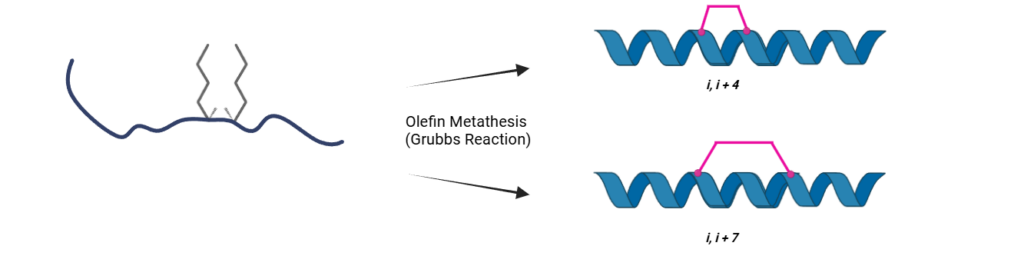
The classical approach to stapled peptide synthesis relies on a ruthenium-based olefin metathesis catalyst (often referred to as a Grubbs catalyst) to introduce hydrocarbon staples into the peptide chain. In this strategy, non‑natural amino acids bearing olefinic side chains are incorporated at defined positions, and subsequent ring‑closing metathesis generates a covalent hydrocarbon bridge that constrains the peptide into an α‑helical conformation.
Stapling Configurations
Hydrocarbon‑stapled peptides are typically prepared by solid‑phase peptide synthesis, introducing two α‑methyl, α‑alkenyl amino acids that carry olefinic side chains of defined length at positions i and i+3, i+4, i+7 along the sequence. After chain assembly, the staple is formed by ring‑closing metathesis, followed by global deprotection and cleavage from the resin.
The design of stapled peptides relies on the site‑specific incorporation of non‑natural amino acids that enable controlled macrocyclization and stabilize the desired secondary structure.

i, i+3
In i, i+3 stapled peptides, the two positions used for stapling are separated by two intervening amino acids along the sequence.
i, i+4
In i, i+4 stapled peptides, three residues lie between the two staple positions, and this spacing often provides the most effective helix stabilization.
i, i+7
In i, i+7 stapled peptides, the staple connects residues that are separated by six intervening amino acids.
Explore Our Peptide Products
Stapled peptides are designed to modulate protein–protein interactions that are often difficult to target with conventional small molecules. They have been widely studied across multiple therapeutic areas, including cancer, viral infections, and cell signaling pathways.
Main protein targets include:
- BCL-2 family proteins (Bcl-2, Bcl-xL, Mcl-1, Bax)
- MDM2 and MDMX (p53 regulatory pathway)
- β-catenin / TCF complex (Wnt signaling)
- NOTCH transcriptional complex (NOTCH/CSL/MAML)
- Estrogen receptors (ERα, ERβ)
- HIV-1 capsid protein (CA)
- SARS-CoV-2 Spike protein (RBD/HR1 domain)
- Bacterial membrane targets (antimicrobial peptides)
Our Expertise in Peptide Engineering
Custom Stapled Peptide Services
Peptide Design
We offer peptide design services to meet your specific research needs.
Hydrocarbon Stapling Techniques
Utilize our advanced stapling strategies to enhance peptide stability and function.
Fmoc Solid-Phase Synthesis
Our synthesis process ensures high purity and consistency in peptide production.
Double-Stapled Peptides
Enhance your research with our innovative double-stapled peptide solutions.
Fluorescent-Labeled Peptides
Track and visualize peptide interactions with our fluorescent labeling options.
Scale-up Production
From small batches to large-scale production, we accommodate your project needs.
Custom Peptide Libraries
Explore our extensive libraries for diverse peptide applications.
Analytical Validation Services
Ensure the accuracy and reliability of your peptides with our validation services.
Custom support & Price inquiry
Address
Reach out to us for a personalized quote or to learn more about our Stapled Peptides products and services. Visit us at 3b Rue de l'Isère
38120 Saint Egrève, FRANCE
Phone
+33 (0) 4 76 45 21 20