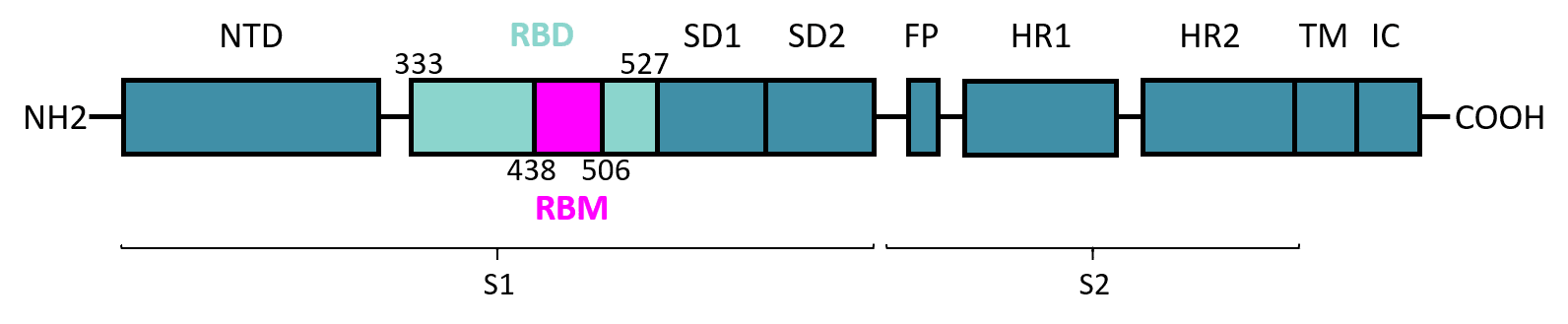
SARS-CoV-2 Spike RBD 319-335 peptide is an epitope of interest of the SARS-CoV-2 Spike S glycoprotein Receptor-Binding Domain (RBD). SARS-CoV-2 Spike RBD 319-335 peptide is useful for vaccine development and for structure-activity relationship studies.
SARS-CoV-2 Spike (S) glycoprotein
Spike (S) glycoprotein corresponds to one of the leading targets for COVID-19 disease. Present on the surface of Sars-CoV-2 virus,Spike S protein is a class I fusion protein that allows the virus to enter host cells.
With a 1 273 aa length,Spike protein has 2 subunits : S1 contains the receptor-binding domain RBD and S2 induces the fusion of the viral envelop with the cellular membrane.
SARS-CoV-2 Spike RBD
The receptor-binding domain in SARS-CoV-2 Spike protein allows binding to the Angiotensin-Converting Enzyme receptor 2 (ACE2 receptor) which mediates the viral entry.
A new and highly pathogenic coronavirus (severe acute respiratory syndrome coronavirus-2,SARS-CoV-2) caused an outbreak in Wuhan city,Hubei province,China,starting from December 2019 that quickly spread nationwide and to other countries around the world1 ,2 ,3. Here,to better understand the initial step of infection at an atomic level,we determined the crystal structure of the receptor-binding domain (RBD) of the spike protein of SARS-CoV-2 bound to the cell receptor ACE2. The overall ACE2-binding mode of the SARS-CoV-2 RBD is nearly identical to that of the SARS-CoV RBD,which also uses ACE2 as the cell receptor4. Structural analysis identified residues in the SARS-CoV-2 RBD that are essential for ACE2 binding,the majority of which either are highly conserved or share similar side chain properties with those in the SARS-CoV RBD. Such similarity in structure and sequence strongly indicate convergent evolution between the SARS-CoV-2 and SARS-CoV RBDs for improved binding to ACE2,although SARS-CoV-2 does not cluster within SARS and SARS-related coronaviruses1 ,2 ,3 ,5. The epitopes of two SARS-CoV antibodies that target the RBD are also analysed for binding to the SARS-CoV-2 RBD,providing insights into the future identification of cross-reactive antibodies.
2- Wanbo Tai et al. Cell Mol Immunol. 17(6):613-620 (2020)
The outbreak of Coronavirus Disease 2019 (COVID-19) has posed a serious threat to global public health,calling for the development of safe and effective prophylactics and therapeutics against infection of its causative agent,severe acute respiratory syndrome coronavirus 2 (SARS-CoV-2),also known as 2019 novel coronavirus (2019-nCoV). The CoV spike (S) protein plays the most important roles in viral attachment,fusion and entry,and serves as a target for development of antibodies,entry inhibitors and vaccines. Here,we identified the receptor-binding domain (RBD) in SARS-CoV-2 S protein and found that the RBD protein bound strongly to human and bat angiotensin-converting enzyme 2 (ACE2) receptors. SARS-CoV-2 RBD exhibited significantly higher binding affinity to ACE2 receptor than SARS-CoV RBD and could block the binding and,hence,attachment of SARS-CoV-2 RBD and SARS-CoV RBD to ACE2-expressing cells,thus inhibiting their infection to host cells. SARS-CoV RBD-specific antibodies could cross-react with SARS-CoV-2 RBD protein,and SARS-CoV RBD-induced antisera could cross-neutralize SARS-CoV-2,suggesting the potential to develop SARS-CoV RBD-based vaccines for prevention of SARS-CoV-2 and SARS-CoV infection.
3- February 05, 2026. doi: https://doi.org/10.64898/2026.02.02.703244
Many people are affected by post-acute sequelae of COVID-19 (PASC/long COVID, LC). LC has severely affected public health. Features of LC including blood pressure dysregulation, coagulopathies, hyperinflammation, and neuropsychiatric complaints. Mechanisms responsible for LC pathogenesis are not clear. The receptor for SARS-CoV-2 is human angiotensin converting enzyme 2 (ACE2), which binds SARS-CoV-2 spike protein receptor-binding domain (RBD) to initiate infection. We hypothesized that some people produce anti-RBD antibodies that sufficiently resemble ACE2 structure to have ACE2-like catalytic activity. Those antibodies, ACE2-like abzymes, may contribute to LC pathogenesis. We previously showed that ACE2-like activity was associated with immunoglobulin in some people with acute and convalescent COVID-19. ACE2-like catalytic activity correlated with blood pressure changes following moderate exercise challenge in convalescents. We screened human monoclonal antibodies (mAbs) against SARS-CoV-2 spike protein from 4 sources. We identified 4 human mAbs with ACE2-like catalytic activity. The activity was not inhibited by MLN-4760, a compound that inhibits native human ACE2, nor by EDTA, unlike native ACE2, a Zinc metalloprotease, but was inhibited by an overlapping pool of Spike peptides. Enzyme kinetic studies showed that the mAbs had lower Vmax and Km values than ACE2. The data suggested that the antibodies cleave angiotensin II via a different mechanism than ACE2. Identification of mAbs with ACE2-like catalytic activity supports the hypothesis that antibodies induced by SARS-CoV-2 infection could help mediate the pathogenesis of COVID-19 and LC, and more generally, the hypothesis that catalytic antibodies induced by infectious agents can contribute to disease pathogenesis.
This website uses cookies to ensure the operation and security of the website.
If you click on “Accept all”, we and third-party providers will process your personal data and store information (e.g. through cookies) on your device or access it. By clicking on the “Settings” button, you can view details of the processing, set your preferences, and reject processing operations that require consent.
Functional
Toujours activé
The technical storage or access is strictly necessary for the legitimate purpose of enabling the use of a specific service explicitly requested by the subscriber or user, or for the sole purpose of carrying out the transmission of a communication over an electronic communications network.
Préférences
The technical storage or access is necessary for the legitimate purpose of storing preferences that are not requested by the subscriber or user.
Statistiques
The technical storage or access that is used exclusively for statistical purposes.The technical storage or access that is used exclusively for anonymous statistical purposes. Without a subpoena, voluntary compliance on the part of your Internet Service Provider, or additional records from a third party, information stored or retrieved for this purpose alone cannot usually be used to identify you.
Marketing
The technical storage or access is required to create user profiles to send advertising, or to track the user on a website or across several websites for similar marketing purposes.